
Runners hate missing workouts, no matter how sick they get. But there are times when training whilst being ill can be unwise, not to mention counterproductive or dangerous.
As the cold and flu season is upon us, follow a few simple guidelines to train smart and, if you do fall ill, recover fast!
So how to stroll though the cold and flu season so you don’t miss weeks of training?
Training hard or racing can sometimes make us more susceptible to getting sick as we repetitively push our body hard. While moderate exercise can benefit the body, researchers have shown that intense exercise can decrease the body’s immune system.
How much exercise can compromise your immune system and increase your chance of getting sick?
For most of us, it may be after prolonged exertion of more than 90 minutes.
Here is an interesting fact! It is thought that runners who train 60 miles a week or more double their odds of getting ill compared with those training less than 20 miles per week.
This doesn’t mean of course that you have to stop training all together.
Think quality, not quantity!
Instead, follow a well-designed progressive training plan that offers sufficient recovery and avoid overtraining; eat a healthy, balanced diet; get adequate sleep; pay close attention to your hydration and be particularly vigilant about washing your hands to avoid cross-contamination in the first place. Your fitness won’t improve in a week (FACT!) but you can certainly become a weaker athlete by training when you’re sick.

You can train with a common cold—in moderation.
By exercising regularly, you are already reducing your chances of getting the common cold. Researchers found that those who exercised moderately and consistently (45 minutes five days a week) experienced half as many colds as those with sedentary lifestyle.
Having said this, it’s almost inevitable that you will get a cold this year. According to the National Institute of Allergy and Infectious Diseases, adult Britons suffer 2 to 4 colds per year. And although nobody feels good when they have a head cold, research says people can exercise.
Watch out! This doesn’t give you a green light to go as hard as you can though. It’s vital you pay attention to your symptoms!
Follow the “neck rule” to determine whether you are too sick to train.
We always tell athletes to use this simple rule to help determine whether they are too sick to train.
If you experience symptoms above the neck—a runny nose, nasal congestion or sneezing—light to moderate (40 to 60% of your aerobic capacity) exercise might be of some benefit. But intense exercise (70 to 80% of your aerobic capacity) has the potential to make the relatively minor illness more severe.
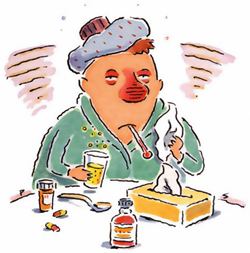
But if you experience symptoms below the neck or body-wide symptoms (in your chest and lung such as a cough that is not from post-nasal drip, or fever, fatigue or stomach issues), a rest from exercise is the recommended approach.
Why?
Below-the-neck symptoms can denote more serious illnesses – bronchitis, influenza, pneumonia—that, in their most serious forms, can require hospitalisation or at least many weeks of recuperation. During illnesses like this, the lining of the respiratory tract breaks down leaving you more susceptible to a bacterial super infection on top of the pre-existing viral one.
Stay healthy and train smart!
The bottom line is if you have a fever, shortness of breath, a chesty cough, or feel generally tired even when not exercising; stop training until your symptoms improve.
